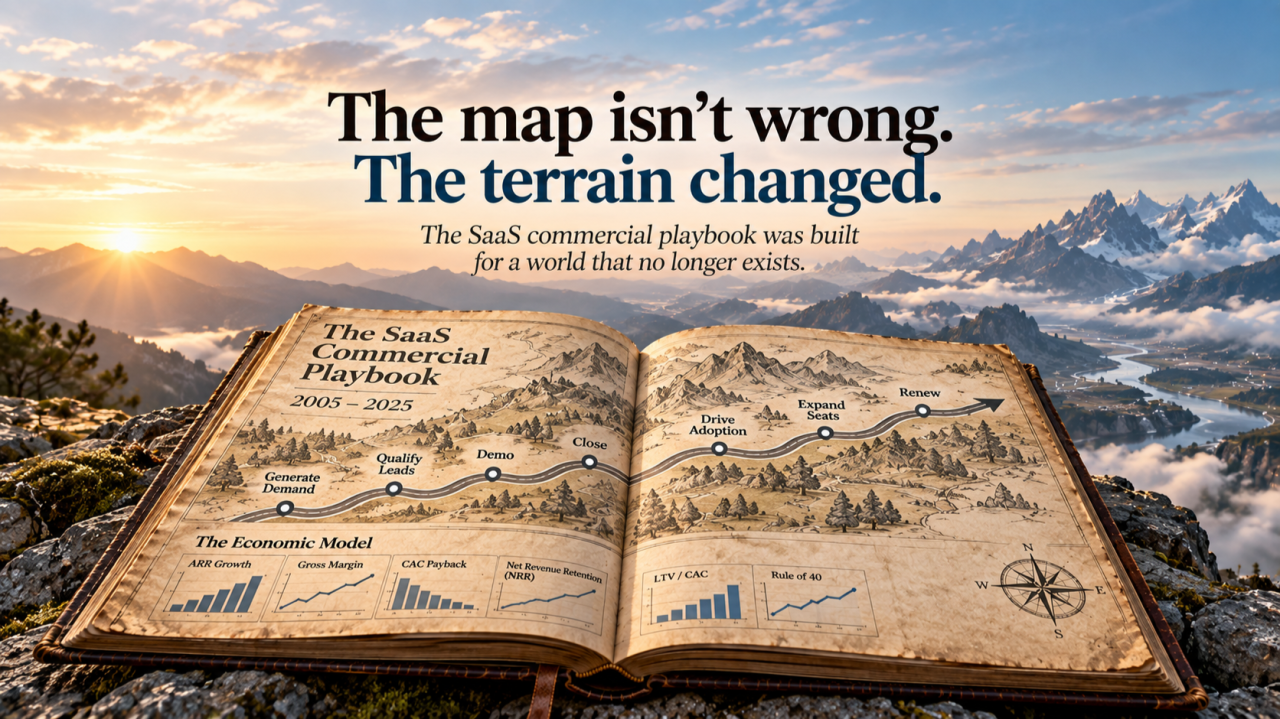
AI is changing software faster than the SaaS playbook built to market, sell, price, and support it can evolve.
For the last 20 years, we built an extraordinarily effective commercial playbook for SaaS: Define the ICP. Generate demand. Qualify the opportunity. Demonstrate the product. Land the customer. Drive adoption. Expand seats. Renew. We built specialized organizations around every step: Marketing generated leads. SDRs qualified them. AEs sold them. Solution consultants demonstrated the product. Customer Success drove adoption and expansion. RevOps instrumented the machine. Additionally, we built an entire economic model around it: ARR growth, gross margin, CAC payback, NRR, LTV/CAC, Magic Number. It worked remarkably well.
But I wonder if we've built a commercial system perfectly adapted to an environment that no longer exists.
AI isn't simply making software better. It's changing the relationship between the product, the customer and the commercial organization. Think about how software development used to work. Salespeople spent uncomfortable amounts of time waiting for features. Customers would ask for something the product couldn't do. Sales would bring the request back to Product. Product would prioritize it. Engineering would eventually build it. Months later, Sales finally had the functionality customers had already been asking for. The customer and the commercial organization were often ahead of the product.
AI may be reversing that relationship.
Code can now be written and functionality introduced so quickly that Product can increasingly create capabilities faster than customers and sometimes the commercial organization itself can understand how to use them. The product is starting to get ahead of the market, and that changes almost everything.
Consider a claims department at an insurance company.
If I'm selling software that makes claims adjusters 20% more productive, the value proposition is relatively straightforward. Same people. Same workflow. Same organization…Better tool. But suppose I'm selling an AI-enabled platform capable of performing 50% of the work currently being done by the claims organization. I'm no longer really selling software, instead I'm proposing a different operating model: Which work should humans still perform? Which decisions should be automated? What happens to staffing? How should workflows change? What controls are required? What happens to customer experience? The old SaaS playbook wasn't designed for that conversation, and this is not just a Sales problem:
Marketing can't simply generate campaigns around features. It has to continually translate rapidly evolving technical capabilities into business outcomes customers may not yet realize are possible.
Sales can't simply discover pain and demonstrate functionality. It increasingly has to help executives imagine a different way of operating their business.
Pricing becomes more complicated. Per-seat pricing makes intuitive sense when software makes each employee more productive. What happens when the software performs a meaningful percentage of the work those seats used to perform?
Customer Success can't simply drive adoption, utilization and renewal. If capturing the value requires redesigning workflows and roles, CS increasingly starts looking like a transformation consulting organization.
Oh yeah…and then there are the KPIs.
What does product adoption tell us when the desired outcome may actually be less human interaction with the software? What does seat expansion mean when the product's value proposition may be eliminating seats? Does NRR tell the same story when pricing migrates from users toward transactions, workflows, or outcomes? Even some of the measurements we've used to define a healthy SaaS company may become less informative as the underlying value proposition changes.
There is a historical parallel
In the 1990s, SAP and Baan weren't simply technology purchases. Implementing them frequently required companies to rethink fundamental business processes. Systems integrators became enormously important because somebody had to bridge the gap between what the technology could do and what the organization was capable of doing with it. I wonder if we're heading back toward a version of that world, and that creates a particularly interesting problem for smaller SaaS companies.
Imagine a $50M SaaS company whose product can genuinely transform how its customers operate. To sell that value, it may now need industry experts, value engineers, transformation consultants, and change-management capabilities surrounding the product. But here's the problem: Consulting economics don't scale like SaaS economics.
The traditional SaaS model benefits from very high gross margins and relatively low incremental delivery costs. Add significant human expertise to every sale and implementation, and some of the economics that made the model so attractive begin to change.
So the $50M SaaS company faces a difficult choice: Build those capabilities itself and potentially compromise the economics? Ask traditional SaaS salespeople and CS teams to become transformation consultants? Build an ecosystem of partners who can provide the expertise? Or accept that customers may never capture everything the product is capable of delivering?
That's not only a commercial problem. It's a business-model problem...
...and that's why we may be looking at this too narrowly when we talk about how "AI is changing software." Product is changing. But so is everything around it. Marketing has to explain a rapidly changing value proposition. Sales has to sell organizational change. Pricing has to capture a different unit of value. Customer Success has to help create the outcome, not simply drive adoption. KPIs have to measure value differently. Channels may need to provide capabilities the software company can't economically build itself. The economics have to work when the solution starts looking more like technology-enabled consulting than traditional SaaS.
We've spent extraordinary amounts of capital making the product smarter. Now Product may be releasing capabilities faster than Marketing can position them, Sales can understand them, Pricing can monetize them, Customer Success can operationalize them, and customers can absorb them.
The next great SaaS innovation may not be in the product. It may be figuring out how to commercialize what the product has already become. Because the SaaS commercial playbook we've spent the last 20 years perfecting may not simply need an update…It may be perfectly adapted to an environment that no longer exists.